Definition Statement
Laptop stands are often too bulky and heavy to carry comfortably, so many students and remote workers leave them at home. Users need a slim, foldable, and aesthetically clean stand that improves ergonomics and airflow without taking up half their backpack.
Who I Am Solving This Problem For
This project is designed for students and mobile professionals who frequently work on laptops in cafés, libraries, and other shared spaces. These users carry their laptops daily but often avoid bringing stands because most options are too large or impractical. It also supports individuals who use high-performance or gaming laptops at home and require better passive airflow during extended use.
Reflection on Multiple Ideas
Initially, I considered a fixed-angle wooden stand with circular ventilation holes. I also explored a fold-out leg system and a modular stacking design for adjustable height. However, these options either lacked portability or added mechanical complexity. After comparing these ideas, I chose a central-hinge foldable design with a gear-slot height adjustment system. This approach balances portability, adjustability, structural stability, and clean aesthetics while remaining mechanically simple. While many laptop stands already exist, I am creating my own design to improve portability, adjustability, and aesthetics, making it a unique solution.
Prototype Description
The prototype will be a foldable wooden laptop stand made of two equal rectangular panels connected by a metal hinge positioned at the center of the base. This allows the stand to fold directly over itself into a compact rectangular slab. The top panel will feature long rectangular ventilation slots lined with metal inserts to enhance passive airflow and durability. Height and tilt will be adjusted using a gear-shaped notched slot system built into the base, where small support blocks can be inserted to hold the stand at different ergonomic angles. A raised front lip and rubber pads will improve stability and prevent slipping. The final prototype will be used for load testing, airflow comparison, ergonomic evaluation, and display.
Somewhat like this:
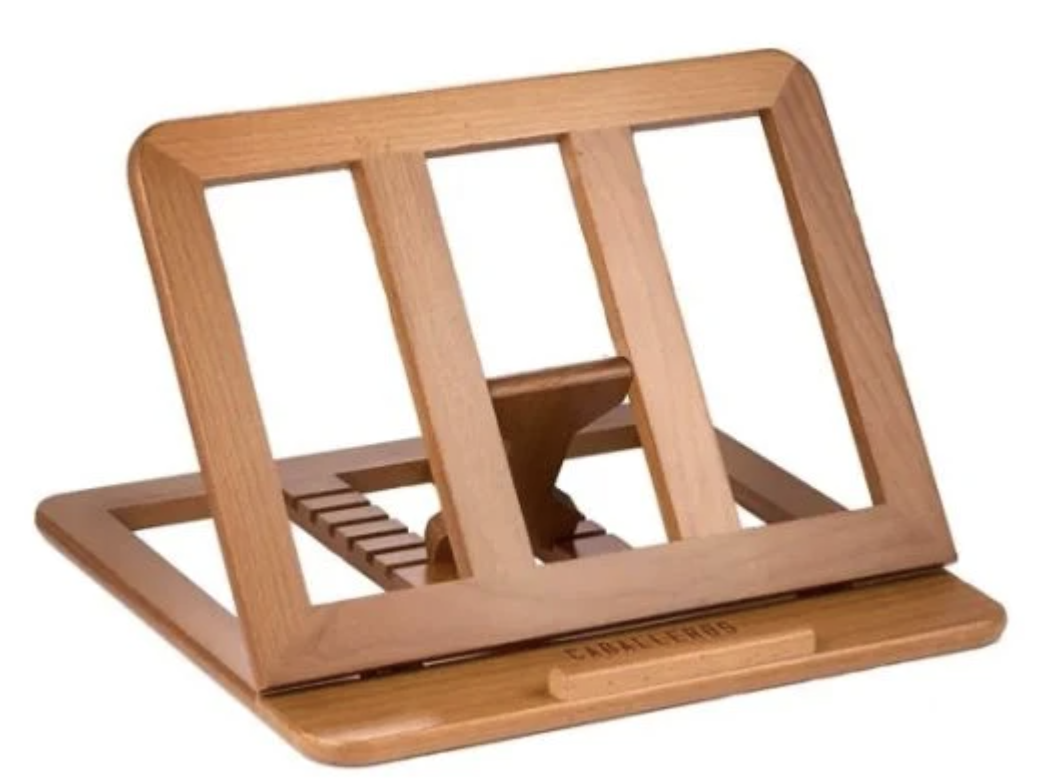
Materials: Lightweight plywood (birch or poplar) for the panels, metal inserts for ventilation, a metal hinge, wooden blocks for adjustment, and rubber pads.
This prototype will be used for testing portability, folding durability, airflow, and ergonomic tilt
Step-by-Step Plan for Prototype
Phase 1 – Final Design & Measurements (Week 1–2: Feb 19 – Mar 3)
- Decide final dimensions for common laptop sizes.
- Sketch technical drawings with ventilation slots, hinge placement, and gear-slot system.
- Learn to space gear-slot notches accurately.
- Test small cardboard or wood model of gear-slot system for angles.
- Note: Keep panels thin enough to stay lightweight but strong.
- Deadline: Mar 3
Phase 2 – Mechanism Testing (Week 3–4: Mar 4 – Mar 17)
- Build a small test model of gear-slot adjustment and support blocks.
- Test stability using a laptop or equivalent weight.
- Adjust notch spacing or block size if needed.
- Learn proper hinge alignment for smooth folding.
- Note: Ensure the overall prototype will be light enough to carry in a backpack.
- Deadline: Mar 17
Phase 3 – Panel Preparation (Week 5–6: Mar 18 – Mar 31)
- Cut two rectangular wooden panels from lightweight plywood.
- Cut rectangular ventilation slots and install metal inserts.
- Attach center-mounted metal hinge.
- Test: Fold and unfold panels to ensure smooth movement.
Phase 4 – Full Assembly (Week 7–8: Apr 1 – Apr 14)
- Install gear-slot system and support blocks.
- Add front lip and rubber pads.
- Test: Stability with laptops at different tilt angles.
Phase 5 – Testing & Refinement (Week 9–10: Apr 15 – Apr 24)
- Test portability (fits in backpack).
- Test airflow performance vs flat surface.
- Test folding durability through repeated use.
- Make refinements as needed.
- Light sanding and finishing.
Phase 6 – Final Refinement (Week 11: Apr 25 – Apr 30)
- Make everything as polished as possible.
- Conduct final tests for stability, weight, and ergonomic tilt.
- Ensure prototype is lightweight, visually appealing, and comfortable to carry.
Summary
By addressing the problem of bulky, hard-to-carry laptop stands, this project provides a lightweight, foldable stand with adjustable tilt, metal-lined ventilation slots, and a sleek, visually appealing design. It’s aimed at students, mobile professionals, and gamers who want better posture, airflow, portability, and something that looks good while they work or play. Through testing, refining, and careful planning, this prototype will demonstrate a practical, ergonomic solution that improves on existing designs while remaining stylish and easy to carry.

Leave a Reply to mcrompton Cancel reply