In fusion we have finally started our first large scale and group project. In this concurring project we will go through multiple steps contributing to a common goal of inhabiting a planet, moon, or star. After locating a planet we will design technology and even a vehicle to improve life on our astronomical body.
After my group and I began research we found multiple moon’s and exoplanets fitting many of the requirements for life. In the end we chose to dive deeper into Titan (Saturns largest of 274 moon’s).
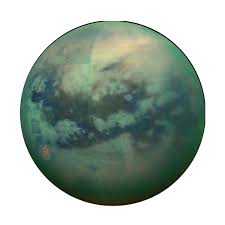
Photo is a no background png of Titan captured by NASA
What is Titan? Why did we choose it?
Titan is Saturns largest moon known for it’s freezing temperatures and nitrogen atmosphere (One of only 7 celestial bodies in our solar system possessing a nitrogen atmosphere). We decided to pursue research in Titan due to it’s distance from earth, and many necessary factors for life it contains. Titan is still within our solar system and takes only 6-7 years to arrive via rockets. The nitrogen atmosphere surrounding Titan protects it from radiation meaning if ways to combat the cold and no oxygen were found we could breath. The gravity on Titan is lower than earths gravity 9.807:1.352 but with way to get high calcium bones will not lose density. The ice on Titan could be melted with proficient levels of heat giving us water and the natural oceans and lakes of hydrocarbons could provide sustainable fuel for millions of years. These hydrocarbons possess more than 35x the amount of energy as Earths fossil fuel reserves. Lastly a chemical reaction of 2H2O ->2H2 +O2 would allow for an abundance of oxygen to be created on Titan.
Linking into why we chose Titan are the opportunities we can seize with resource abundances and colonization of astronomical bodies. On the case of opportunities to improve life on Titan the nitrogen atmosphere and severe amount’s of ice and hydrocarbons provide us with many of the needed factors for life. On the other hand opportunities for research such as learning about Saturn and the sustainable energy source in hydrocarbons could benefit our life on Earth as well.
Although Titan proves to have many factors for life to be sustained it lacks a few. I’ve already thought of ways to solve the lack of oxygen problem on Titan but the cold temperatures (-160 degrees celsius) prove to be a tough problem. I also believe that it would be impossible to flow oxygen throughout an entire celestial body with the ice on Titan. Because of this I know building a 300x300m dome to contain oxygen would benefit our chances of inhabiting Titan.
With our current ideas for exploring Titan we couldn’t have humans walk across the moon so having vehicles would aid in exploration. We would be able to locate resources, map the moon, and more with a rover of sorts.
Some issues to keep in mind when designing our vehicle are
(And how to combat them and what problems they bring up)
It being able to withstand beyond freezing temperatures, having a way to control it without signals, and the vehicle staying connected to the surface moving along ice or granulated sand. After a short brainstorming process I found ways to combat our problems. We will use cuppnickel sheets (theoretical) to prevent internal freezing of all the mechanism in our vehicle allowing it to function as originally intended. By theoretical I mean that on the Titan planet it would be required but in this project we will not actually test cuppernickel sheets due to their resilience and having no way to mold or cut the sheets. Ontop of this since Titan is in space signals are impossble to transmit and we will have to make the vehicle only move in a straight line when powered on/off. Lastly, due to Titans lower gravity and unique variety of terrain we must make our vehicle with enhanced traction in mind to prevent the vehicle moving into orbit. We will solve this by having spiked treads to both move along thick ice and granulated sand.
Because Titan is an astronomical body located within our solar system we have been able to send machinery and use image observations to gather information. Data has been collected regarding titan from various organization such as NASA and the Italian Space Agency. On two voyage known as the Cassini and Huygens missions many key details were discovered regarding Titan. Using radars scientists were able to map Titans surface through the foggy atmosphere. Infrared imaging techniques were used to support data regarding Titans surface while also breaking down the form of Titan’s atmosphere. The radar scanning allows us to also view the bodies of hydrocarbons scattered along Titan’s surface. Most of what we know about titan was discovered in the past century however, telescopes were used to analyze visuals of titan as early as the middle 16th century. The voyager missions by Nasa occurring in the late 19th century used a variety of tools such as cameras, and spectrometers to gather data. The spectrometer through releasing waves of UV light were able to gather information on Titans below freezing temperatures. Lastly we discovered that Titan had no oxygen by using radio occultation to make inferences about Titan’s atmospheric pressure hence leading to proven data of no oxygen within Titans atmosphere.
Throughout this project I used multiple sources and a partial use of AI when researching my astronomical body, its characteristics, and how we discovered this data.
AI Transcript
https://docs.google.com/document/d/1RAx45ftgdfWmZ-SDZtFfQZq51VJEIpiDhqKLRxhr6PE/edit?usp=sharing
APA Citation’s List
Carey, F. A. (2025, November 12). Hydrocarbon. In Britannica. https://www.britannica.com/science/hydrocarbon
Fisher, D. G. (2023). Cassini-Huygens probe launched. EBSCOhost Research Starters. https://www.ebsco.com/research-starters/history/cassini-huygens-probe-launched
NASA Science. (2025, May 14). About the Cassini mission. National Aeronautics and Space Administration. https://science.nasa.gov/mission/cassini/about-the-mission/
NASA Science. (2024, July 8). Rover basics. National Aeronautics and Space Administration. https://science.nasa.gov/planetary-science/programs/mars-exploration/rover-basics/
NASA Science. (2025, April 25). Titan: Facts. National Aeronautics and Space Administration. https://science.nasa.gov/saturn/moons/titan/facts/
Thank you for reading my blog post more data regarding my groups progress is coming soon.
Written by Will M

Leave a Reply to mcrompton Cancel reply