The Fusion Personal Project is a project where we use STEM skills to solve a problem of choice. Here’s my definition statement for my problem:
There is a lack of affordable, anatomically detailed, physical musculoskeletal models that clearly demonstrate named deep and superficial muscle layers and ligaments in the anatomical position.
This problem is specifically tailored to people such as anatomy students, hobbyists, art students learning anatomy, independent learners, and many more.
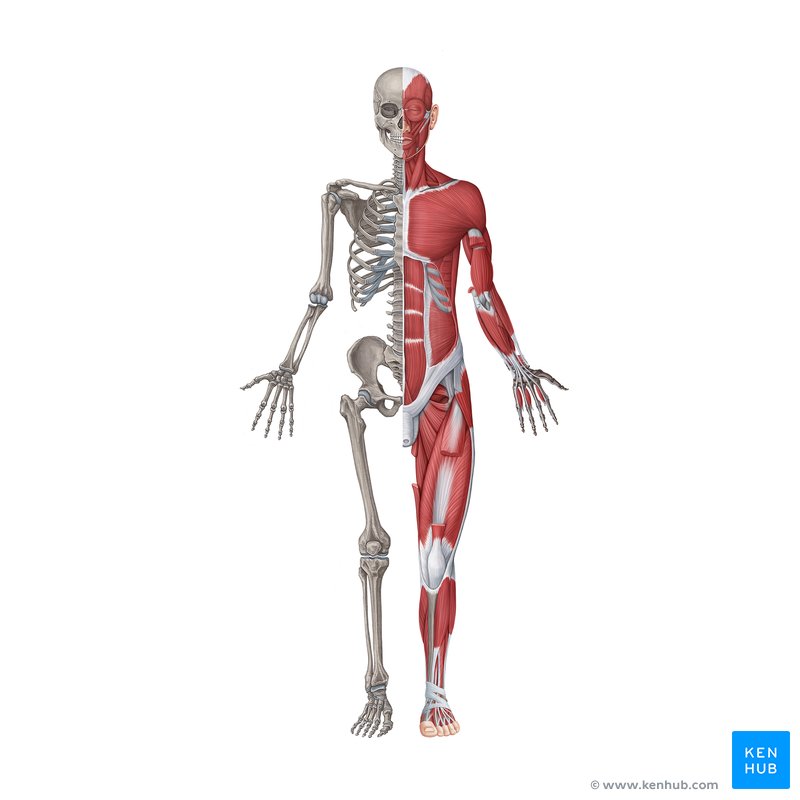
Earlier I took a look at some potential solutions to this problem. Here are a few of them:
- a joint-specific/region-specific modular, musculoskeletal DIY kit that might be articulated
- an interactive app of the musculoskeletal system where people can choose certain sections’ 3D models to print, examine, etc.
- a real life cadaver lab
- a physical downscaled 3D printed model of the musculoskeletal system
Let’s go through these potential solutions to the problem, and look at how well this fits our constraints:
- Joint Specific Modular Kit(could be articulated)
This will be really nice for people learning anatomy, where they care about knowing superficial and deep anatomy. This kit is very helpful for seeing how ligaments, tendons, etc. interact with each other. If it were to be articulated this would be perfect for especially art students, because not everyone is drawing people in the anatomical position.(reference above image for anatomical position)
2. Interactive App for 3D printing
This solution would be great for hobbyists with 3D printers, however that audience isn’t huge. Despite this being a great solution, and someone could definitely try tackling this solution sometime, this isn’t possible for me. I’m not great at coding, so making an app is not quite in the equation, and also there are some existing platforms like NIH 3D(https://3d.nih.gov) that are most of the way there.
3. Cadaver Lab
This is probably something that some anatomy students in university have. Cadavers, or corpses are great for being able to look at anatomical variance, anthropometry, and certain conditions or issues that that body is having. This isn’t very accessible however, and these already exist, not for a Fusion student to use.
4. Downscaled Physical Model
This is not a bad idea. Most models online are upwards of a few thousand dollars(3B Scientific, SOMSO, etc.) and are for professional use. A downscaled version, especially if it were to be 3D printed would cost much less, even if it were a higher quality 3D print, with resin, multi-color printing, etc. The professional models also mostly don’t have naming on them, which makes it harder for people learning to memorize, visualize, etc.
Prototyping?
Now that we’ve went through all these solutions, I think that the downscaled 3D printed model fits our time, cost and expertise constraints the best. What might our prototype look like?
Our prototype will be a downscaled, 3D printed model of the musculoskeletal system in the anatomical position. There will be one deep side and one superficial side for better representation of muscles, bones and ligaments. Visible muscles are labeled in text by TA(Terminologia Anatomica) naming standards. Muscle fiber direction is made visible by colored lines, or texture running parallel to the pennation angle. Certain omitted muscles will be removed, and instead their proximal and distal attachments will be shaded, if they are visible. If they are not visible, they will be removed from the model.
These are the important choices I made for that prototype:
- Anatomical Position— a standard, universal reference point, where directional terms are based on
- Deep & Superficial Sides— faithful to the definition statement, also easier view of the whole body. 2 sides of the same thing is more redundant and less informative than 1 deep and 1 superficial side.
- Naming— I chose to label all muscles, because it doesn’t interfere with the aesthetics of the model, and it adds to the learning. TA is the accepted standard for anatomical terminology. I’m still not sure whether to name bones and ligaments yet, because their visibility is highly nuanced(size, deepness, etc.)
- Fiber Direction— This is important for people more concerned with things like biomechanics. Fiber direction is important to know PCSA(force capacity), muscle architecture, and it adds to the education of the model.
- Omission of Muscles— The human body is extremely complex, and I believe removing some muscles will be more beneficial than detrimental to the model. I’ll get into it soon with an example. I still want the model to be very educational, so I will try to give information about the muscle, by shading both attachments of the muscle.
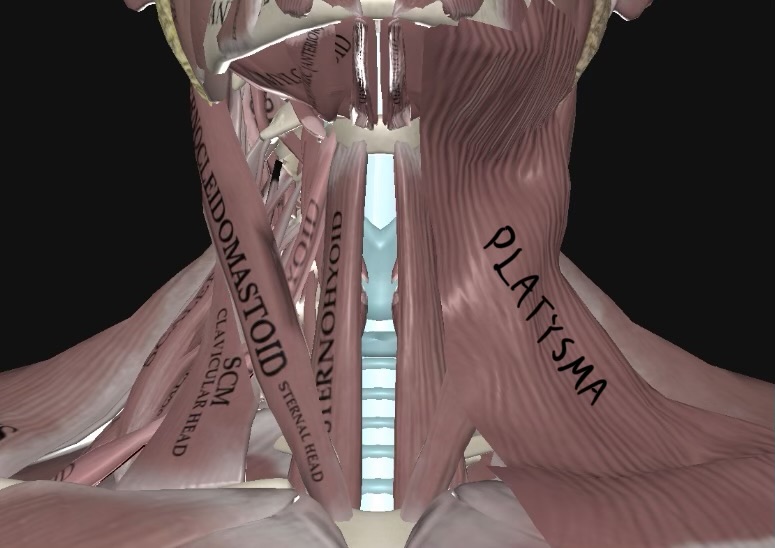
Here is an image from the Muscle and Motion app, where I hid one side of the platysma muscle(labeled on the right). The platysma here covers more than 10 muscles, which in my humble opinion takes away from the learning. This is one of the few muscles I decided to omit.
Planning
What do I need to do to complete this prototype?
- Learn Blender(~1-2 weeks)
I need to learn basics, text, and if needed some other sculpting tools in order to make the fiber direction more obvious.
- Decide on model specifics(~few days)
How do I want my model printed? What exactly am I including in my model?
- Edit my model(already exists)(~4-6 weeks)
I need to name muscles, add fiber direction, remove unnecessary parts, and make the model printable(maybe by adding a base).
- Move my model to another software, compatible with dimensions(optional)
I’m not sure if I can export from Blender to an actual dimensioned model, so if it’s needed at least I covered for it.
- Test print(~1 week)
If anything goes bad at least I made time to retry it.
- Fix anything that I missed/needs fixing(~1 week)
There’s bound to be something that I don’t have complete, so I need to fix those and add anything that I might need.
Conclusion
I think the solution I landed on is a great idea for a personal project. I am looking forward to working on this, and I hope that my project will end in success. Thanks for reading!

Leave a Reply to mcrompton Cancel reply