Definition Statement:
People set personal goals but often struggle to stay consistent because they lack a visible, interactive, and physical system to track their progress throughout the day.
My targeted Audience is busy students and individuals who set goals but struggle to consistently follow through due to the lack of visible, portable, and interactive systems
Ideas:
- A physical daily habit board that resets each day
- I feel like this system would not really be specific enough and would not have enough features to actually make it engaging for the consumers
- An app that tracks habits and shows different statistics
- I felt like the idea of different statistics and habits doesn’t really align. Habits are just habits, and there aren’t many statistics to talk about.
- A mini gadget attached to the phone that tracks your habits
- This was one of my best ideas, but after I realized that if it were mounted onto the back of your phone, it would be uncomfortable for the user because it would make your phone bulky and possibly hard to hold.
- An app that tracks the progress towards your goal
- I kind of pivoted from focusing solely on habits to a more general sense of goals. There is one problem I noticed: many productivity and goal apps have notifications, but people often ignore them or get distracted and switch to other apps on their phones.
- Weekly goal system: 1-3 goals each week, and tracks whether you have worked towards them by the end of each day
- This is the idea I ultimately settled on because it is interactive, portable, and serves my purpose of reminding people of their goals.
First Generation:
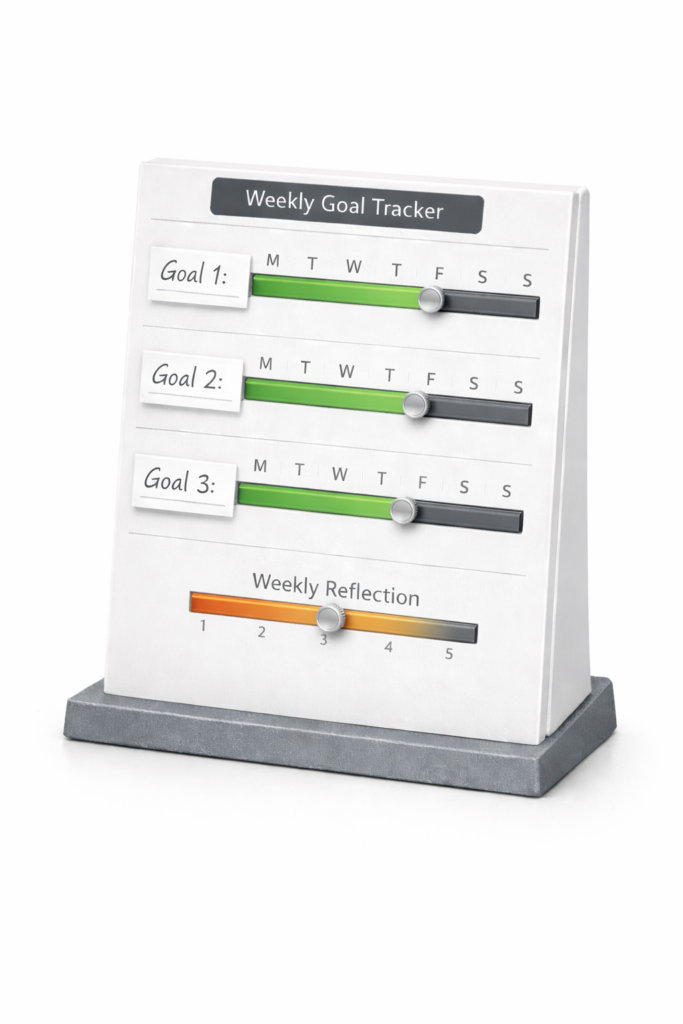
- AI representation of the first-generation weekly goal tracker
After deciding on a weekly goal tracker, I came up with the idea shown above. It is a goal tracker that can be placed on your desk and has 3 goal columns, where you can toggle the knobs in the slots to record the days you have completed the goal.
I chatted with Mr. Crompton and realized this is a passive, not an active, way of tracking. It is not that interesting, and there is no incentive to perform the goal each day.
Afterall, this might just be a product that will be forgotten on your desk and never to be touched again.
Some Research:
I felt like some research that would support my incentive of creating this system would help me understand the logic better and have a clearer vision:
According to Psychology Today:
Research on habit tracking suggests that physically interacting with a goal tracker (e.g., writing things down, checking off boxes) helps create stronger feedback loops in the brain and lowers cognitive load compared to purely digital tracking. Studies of habit tracking show that making a behaviour visible — especially in a tactile, physical way — can help reinforce routines because the act of interacting with the tool itself becomes a cue or reminder.
According to the New York Post:
Surveys and lifestyle research show that people often forget digital reminders on phones and apps, while physical tools placed in visible locations are more likely to be noticed and acted upon. In a recent consumer study, many participants reported that physical goal reminders (such as sticky notes, printed trackers, or tangible cues) helped them stick to their goals more than digital reminders, because digital alerts are easy to dismiss or forget.
According to Habit Coach:
Research on habit tracking shows that regular self-monitoring and visible progress markers significantly increase the likelihood of achieving goals, regardless of the tracking method. Studies suggest that physically interacting with a tracking tool — such as marking a checkbox or moving a physical slider — strengthens habit feedback loops and reduces cognitive load compared to passive digital tools. Additionally, surveys indicate that physical reminders are more likely to be noticed and remembered than digital notifications, which are often ignored or forgotten.
Introducing GoalDock:
A modular, portable goal-tracking system that combines detachable daily reminder modules with a home docking station to help users build consistent habits and work towards their goal through visible, interactive feedback.
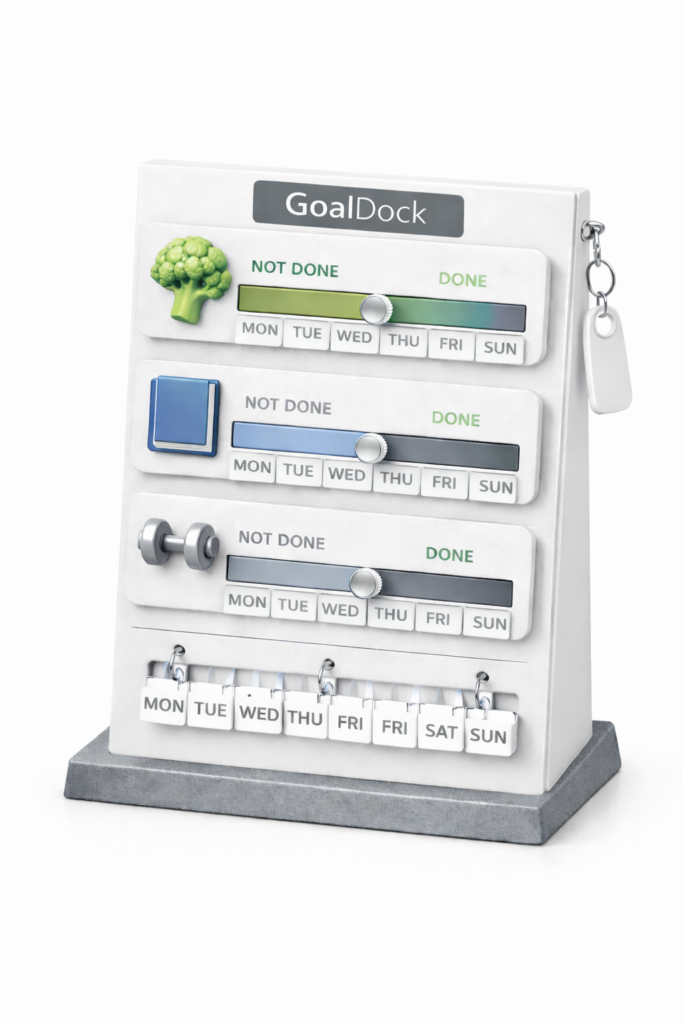
- AI representation of what the product would look like
2 parts to the System:
- 3 Detachable Goal Slots
- A docking stand/station
The Detachable Goal Slots:
- Each detachable goal slot consists of a few features:
- A 3D icon: the icon is a visual representation of the goal. For example, if the goal is to eat healthy, the icon would be a broccoli or an apple, symbolizing health.
- A name slotfor the goal: Obviously, an icon would not be specific enough. That’s why there will be a slot for the user to write the specific goal they want to achieve.
- A slider: The slider has 2 positions: “Done” or “Not Done”. When the task is completed, the user can simply toggle the slider to the “Done” position and keep it there.
- A Monday – Sunday mini column: This mini column appears underneath the slider and shows the consistency of working towards the goal from Monday to Sunday.
- A hook/ small ring: A hook or a small ring would be attached to the slots. This allows the user to place the slot anywhere they like, from backpacks to pencil cases to phones. This helps the user remember what they aim to achieve by the end of the day.
The Docking Station:
The docking station would be returned home, where it can sit on the user’s desk or workspace. It serves not only as a holder for the 3 detachable goals but also as a tracker of the overall consistency of the goals this week. For example, the user can record the number of days they ate healthily, read a book, or work out. This helps the user reflect on the week’s progress with a visual cue.
Materials needed:
The bulk of the materials needed for the project would be 3D printed (especially with the 3D icons). The knob for the slider could be made from materials that feel smooth and pleasant to the touch, such as aluminum, to encourage the user to complete the task for the day.
The docking stand could also be made of metal to create a clean, minimalist vibe that will be satisfying to look at.
Magnets might be needed if the slots are magnetically attached to the docking station.
Plan for Creation:
- Finalize the Design
- Although the design is kind of finished, I might need a bit more time to refine a few concepts
- Create the CAD designs
- Figuring out which parts to create by myself and which parts to buy online would be a major part of this step
- Research materials needed for the 3D printing
- Different materials might be needed for different parts of the product
- I will need to know how to send the CAD designs to the 3D printer as well
- Print the parts that I will make myself, and buy the other parts
- Construct a first prototype and test it
- Reflect on the mistakes and make any adjustments needed
- Construct a second prototype and perform a test
- Make any adjustments necessary
- Create the final product
Conclusion:
Overall, I believe this product will address the problem of inconsistent goal achievement because it is visual, interactive, and portable.

Leave a Reply to mcrompton Cancel reply