Definition Statement/Problem and Audience(Not changed):
Beginner and intermediate racing drivers often struggle to learn effective driving lines for their specific cars because most learning occurs on real racetracks, where practice is expensive, time-limited, and sometimes risky.
The main intended audience for this project is to beginner and intermediate drivers who may:
– Do not have professional coaching
– Cannot afford frequent track days/Don’t have time
– Interested to improve their racing in different tracks
Solution to the problem(for more details navigate to the initial pitch post)
Racing line simulation project. A simulation that is able to take in BASIC INFORMATION of a car and a track and generate the MOST OPTIMIZED line to the track of that car.
Research done
The most important and key part of the project is the physics and input I would need to have from the User to generate my output. From the research done, the simulation would require:
CAR VARIABLES:
- Vehicle Mass (kg)
- Grip of the car
- Engine Power (hp)
- Maximun breaking force
- Aerodynamic downforce (if possible but is optional)
TRACK VARIABLES
- Corner Radius (m)
- Corner Angle
- Straight lengths (m)
Some of these variables would require calculation to get and also difficult to understand especially for beginner drivers for example the maximum breaking force and the grip of the car. For these specific variables, instead of inserting a value for this requirement, the plan is to make the user insert multiple other statistics about the car to calculate these variables.
Calculation and Physics
There are multiple physics models required for the calculation
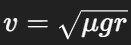
1. Cornering speeds (grip Limit of the car)
V = maximum speed through the corner (m/s)
μ = tire grip coefficient
g = gravity (9.81 m/s²)
r = corner radius (m)
2. Maximum breaking force
F = maximum braking force (N)
μ = tire-road friction coefficient
m = mass of the car (kg)
g = gravity (9.81 m/s²)

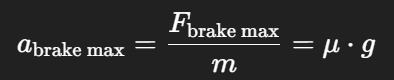
3. Maximum breaking acceleration
a = maximum possible braking acceleration (m/s²)
μ = coefficient of friction between tires and road
g = gravity (9.81 m/s²)
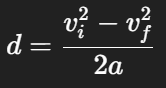
4. Braking Distance
d = distance needed to slow down(m)
vi = initial speed before braking (m/s)
vf = target vorner speed (m/s)
a = braking acceleration(m/s²)
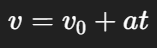
5. Acceleration
V = velocity after time t (m/s)
v0 = initial velocity (m/s)
a = acceleration (m/s²)
t = time (s)
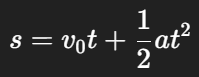
6. Distance while accelerating
s = distance traveled while accelerating (m)
v0 = initial speed (m/s)
a = acceleration (m/s²)
t = time (s)
Challenges
The main challenges of this process if the amount and difficulty of the coding required to do all of the calculations and physics. One of the different takes that may influence the prjects could be implimenting machine learning into the simulation. Machine learning would be more efficient and probrably less difficult to accomplish.
Future steps
Due to the perspective of using machine learning in this project, more research would have to be conducted about AI in order for the project to be continued
Leave a Reply