Introduction
This blog will report my research on the Habitability of our closest exoplanet – Proxima Centauri B – and its potential challenges. This will inform my next steps to explore potential devices for humans who wish to survive there.
Our Closest Solar Neighbour
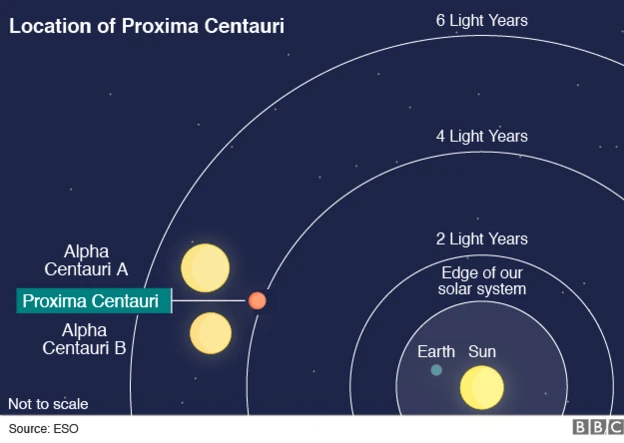
Proxima Centauri is the nearest star to us. It is still far to travel there, but we are in a hope of advanced technology of space vehicle to make it happen.
>> Discovery
- Robert T. A. Innes (1917) discovered Proxima Centauri. He used photographic astrometry to estimate the distance (4 light-years) and gave the name “Proxima” to the star, meaning “nearest in Latin”.
>> Mass Estimation
- According to the data used by Anglada-Escudé et al. (2016), Proxima Centauri has an estimated mass of only 0.120±0.015 times that of the Sun, a radius of 0.140±0.012 times that of the Sun and an effective temperature of 3050±100 K. It is among the smallest main sequence stars known with a mass only about a third again more than the least massive normal star theoretically possible.
Potential Earth-Like Planet
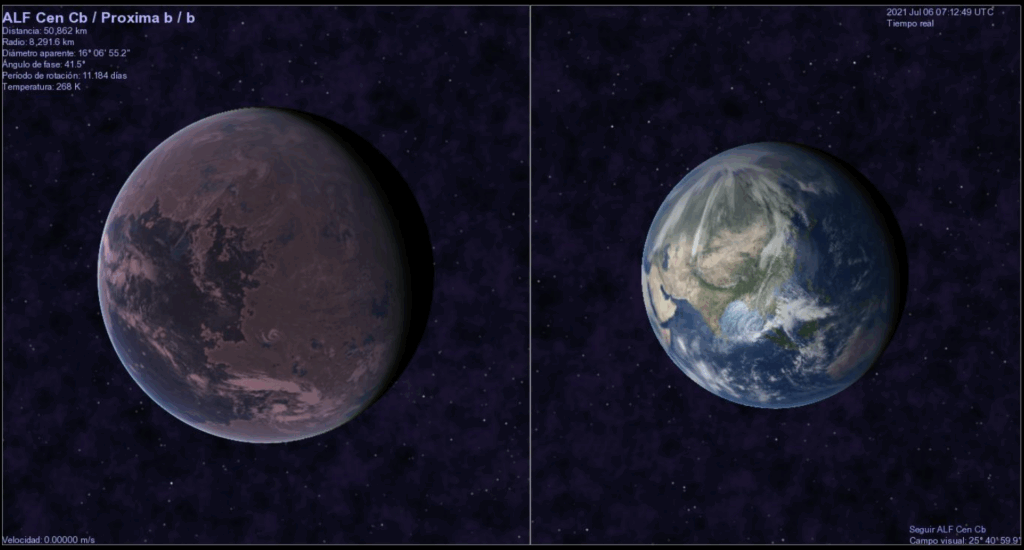
Proxima Centauri B is the closest planet to Proxima Centauri.
>> Discovery and Distance
- Proxima Centauri B was found using Radial Velocity (Anglada-Escudé et al.,2016). Radial Velocity also gives us the Orbital Period, Minimum Mass, Eccentricity, and the Semi-Major Axis.
- Orbital distance: 0.05 AU (5% of the Earth-Sun distance)
- Orbital period: 11.2 days
- Multiple independent telescope datasets confirm the same orbit.
Proxima Centauri B is similar in size and mass to our home planet – Earth, which may signal Earth-like physical conditions that are suitable for human living.
>> Mass Estimation – minimum 1.27 Earth Masses
- Minimum Mass: Anglada-Escudé et al. (2016) estimated the minimum mass of Proxima Centauri B by using Radial Velocity measurements from HARPS and UVES.
- Maximum Mass: Based on statistical analysis of Kepler results performed by Leslie Rogers (Hubble Fellow at Caltech) and others, it is known that exoplanets seem to transition from being predominantly rocky to predominantly volatile-rich probably at a radius of about 1.5 RE and certainly no greater than 1.6 RE. A planet with this radius corresponds to a mass of about 6 ME, assuming an Earth-like composition. With an unconstrained orbital inclination, there is about a 98% chance that Proxima Centauri b (minimum mass of 1.27 ME) has an actual mass below this threshold.
>> Size Estimation – 1.1~1.3 Earth radii
- Proxima Centauri b’s radius was not measured directly but estimated by empirical models with assumption of rocky composition and no large gas envelope.
- The calculation was based on Mass-Radius Relation from other known rocky exoplanets and the 1.27 minimum Earth masses.
- Anglada-Escudé et al. (2016) mentioned that there is a 1.5% chance that the orbit of Proxima Centauri b is oriented to produce transits visible to us here on Earth. If such transits actually occur, the actual mass and the radius of this new exoplanet could be determined in the near future.
>> Rocky Composition or Ocean Planet?
- Based on the estimated minimum mass, the planet is likely rocky comparing other planets in this mass range (Anglada-Escudé et al.,2016)
- Brugger et al. (2016) modelled possible compositions and confirmed that a rocky planet with or without some water is the most plausible scenario.
Potential Habitable Features
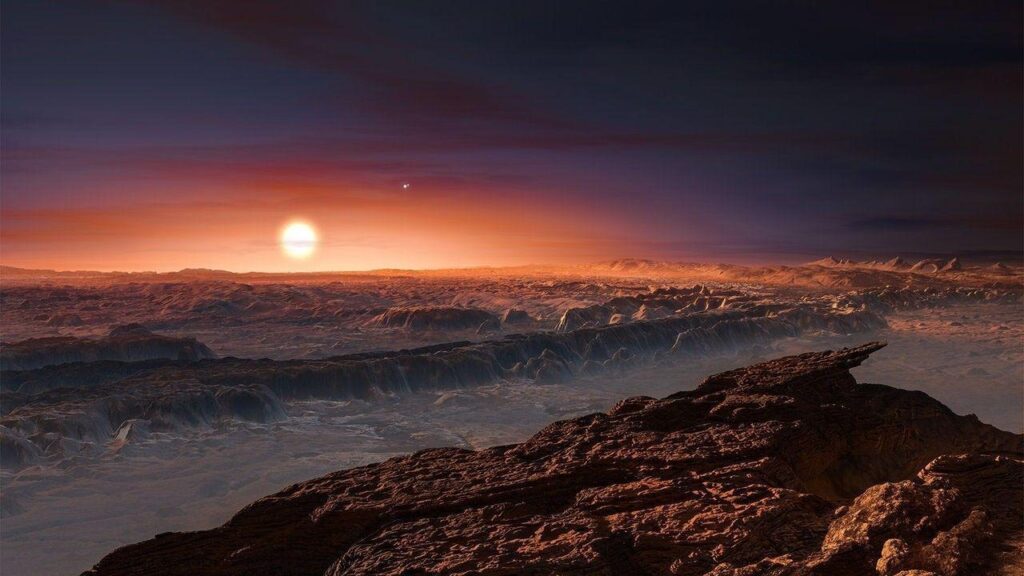
Proxima Centauri B is within the habitable zone of Proxima Centauri. It speculatively has habitable Features.
>> What is the Habitable Zone (HZ) of a star?
- The HZ of a star is the region around a star where the temperature of an exoplanet could be good for liquid water to exist.
>> How do we know Proxima Centauri B is within Proxima Centauri HZ?
- Based on detailed climate and geophysical modelling, for a star like Proxima Centauri with a surface temperature of 3050 K and an Earth-size planet orbiting Proxima Centauri, the outer and inner limit of the HZ is between 0.081 AU and 0.041 AU. (Kopparapu et al.,2013, 2014). Proxima Centauri b is 0.04848 AU from Proxima Centauri.
Gravity Conditions may be suitable for life
>> Habitable Range
- 0.75 – 1.05 times Earth gravity calculated by gravity formula with mass and radius of Proxima Centauri b.
- The estimated gravity is within a habitable range (0.5-2g Earth gravities).
Temperatures could be liveable with an Earth-like atmosphere
>> How would we estimate it?
- Meadows et al. (2018) used climate-photochemistry models to simulate several plausible states for the atmosphere environment of Proxima Cen b. For Earth-like atmosphere, only modest amounts of carbon dioxide (0.05 bar) or methane (0.01–0.03 bar) are required to warm the planetary surface and can obtain cold but habitable surface conditions.
>> Complicating factors – Atmosphere and Rotation
- Stellar flares could strip the atmosphere to make the surface hostile.
- Tidally locked: 7°C to 27 °C on dayside, -223°C to -123°C on nightside depending on atmosphere thickness. With ocean heat transport, temperature differences are smaller. (Turbet et al.,2016 using 3D climate models)
Water as the source of life may exist within the HZ
>> How would we know?
- No direct observation yet of liquid water (or water vapor) on Proxima b.
- Most of our estimates are based on theoretical modeling and simulations.
- Water could possibly exist on Proxima Centauri b according to many models. Brugger et al. (2016) showed models where up to ~50% water by mass is possible, leading to a deep global ocean. Coleman et al. (2016/17) modelled several distinct formation paths and found that the planet’s water content depends strongly on where and how it formed. Meadows et al. (2018) found that whether water is currently present depends heavily on atmospheric composition and how much the star’s radiation has stripped things away over time.
A range of gases (CO₂, N₂, H₂O) may exist to support human life, plant growth, and protect inhabitants
>> How would we know?
- Noack, Kislyakova, Johnstone, et al. (2021) modeled interior heating (including induction heating) and long-term outgassing for Proxima b, and suggested that volcanic outgassing could supply CO₂, H₂O, and other volatiles, depending on interior composition and thermal evolution. This is important because the supply of gas from the planet’s interior could help maintain an atmosphere against losses.
>> Atmospheric Challenges
- The potential gases depend on planet’s formation and atmospheric retention.
- Many models suggested that high stellar flaring, XUV flux, and particle radiation significantly influence atmospheric chemistry and loss.
Potential Challenges
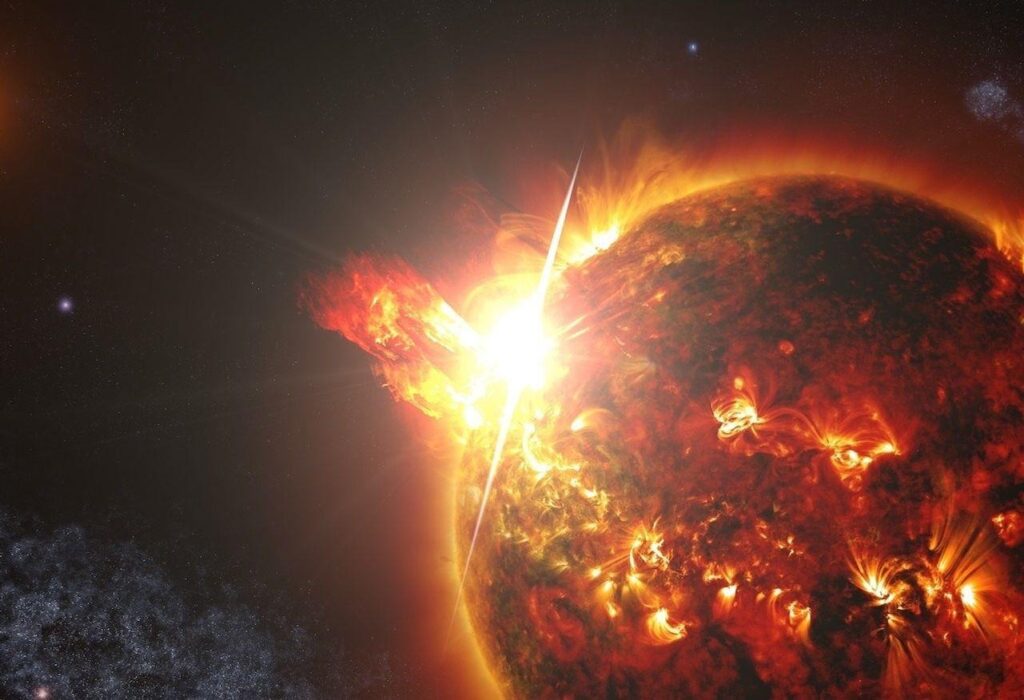
Damaging Stellar Flares
>> Harmful effects on Proxima Centauri b
- The high-energy radiation from the stellar flare can heat and erode the atmosphere, break apart water molecules, destroy potential ozone layer, and threaten any potential lifeforms on the surface.
- Entire spectrum of electromagnetic radiation
>> Extremely strong X-ray and UV radiation
- Proxima b’s XUV (X-ray + extreme-UV) flux is much higher than Earth’s; “nearly 60 times higher than Earth” for its high-energy flux, according to full spectral energy distribution model constructed by Ribas, Gregg, Boyajian, & Bolmont (2017).
>> Extremely high-energy solar flare burst
- The biggest flare briefly made the star 14,000 times brighter than normal as observed by MacGregor led group in 2019 by using simultaneous observations with nine telescopes. (NASA, 2017)
Very Thin or Absent Atmosphere
- Atmospheres are also essential for life as we know it: Having the right atmosphere allows for climate regulation, the maintenance of a water-friendly surface pressure, shielding from hazardous space weather, and the housing of life’s chemical building blocks.
- Stellar flare strips away the atmosphere and Earth-like atmosphere would not survive. Katherine Garcia-Sage et al. (2017)’s model suggested that Proxima Centauri’s powerful radiation drains the Earth-like atmosphere as much as 10,000 times faster than what happens at Earth.
Lack of Strong Magnetic Field Protection
- Interior models suggested magnetic fields are possible and likely multipolar in nature due to slow rotation speeds. The field strength was predicted to have values of 0.06 – 0.23G. (Herath et al., 2010). It is lower than Earth magnetic fields value ~0.3G.
Tidally Locked Orbit
- Proxima Centauri B is also highly likely to be tidally locked, as it is much closer to Proxima Centauri than Earth to the Sun. Rather than having a day/night cycle like Earth, Proxima Centauri B would have one hemisphere in constant sunlight, and the other in constant dark. (NASA, 2020)
Potential Vehicle Design Implications

https://wallpapercat.com/finch-movie-wallpapers
Thermal Control
- Without a thicker atmosphere, the vehicle must be heavily insulated with active thermal control systems to maintain stable temperatures.
Heavy Shielding
- The vehicle must have heavy shielding to protect its vital components from radiation and cosmic rays. (for example, lead)
Dust Protection
- The vehicle’s joints and sensors may need to be sealed and protected to prevent dust (like on Mars) from wearing down and disrupting components.
Autonomous Navigation
- Sometimes there are environments where it is too difficult or expensive to protect humans on the vehicle, so the the vehicle would need Autonomous Navigation to move without human control. Additionally, Autonomous Navigation may be able to control a bulky vehicle in unknown environments better and safer than a human could.
Movement
- Without a thicker atmosphere, the vehicle cannot rely on any form of aerodynamic movement or braking.
Limitation on Data Collection
Due to the fact that Proxima Centauri B hasn’t transitted, it eludes the usual method for learning about its atmosphere. Instead, scientists must rely on models to understand whether the exoplanet is habitable.
>> What is a Transit?
- A transit occurs when a planet passes between a star and its observer. Transits within our solar system can be observed from Earth when Venus or Mercury travel between us and the Sun. (NASA, 2020)
- The planet passing in front of its star ever so slightly dims its light. This dimming can be seen in light curves: graphs showing light received over a period of time. (NASA, 2020)
- However, Proxima Centauri B has not been detected passing in front of its star. (NASA, 2020)
>> Importance of Transits
- Transits can help determine a variety of different exoplanet characteristics: the size of its orbit, its orbital period, and the size of the planet itself. (NASA, 2020)
- We can also learn about an exoplanet’s atmosphere during a transit. As it transits, some light will go through its atmosphere and that light can be analyzed to determine what different atmospheric elements influenced its particular dispersion. (NASA, 2020)
- These can help determine the temperature of the planet itself. This can tell us whether the surface has a comfortable temperature suitable for life. (NASA, 2020)
AI Use Statement
I asked AI specific questions and resources for its answers. Then I selected the resources I used and found their original papers to ensure the credibility of the answers.
References
Anglada-Escudé, G., Amado, P., Barnes, J. et al (2016). A terrestrial planet candidate in a temperate orbit around Proxima Centauri. Nature 536, 437–440. https://doi.org/10.1038/nature19106
Barnes, R. (2024). Can Humans Live on Proxima b? – Analyzing the Current Facts. PaleRedDot Exoplanetarium https://www.palereddot.org/opportunities-and-obstacles-for-life-on-proxima-b/
Brugger, B., Mousis, O., Deleuil, M., Deschamps, F. (2017). Constraints on Super-Earth Interiors from Stellar Abundances. The Astrophysical Journal 850 https://www.doi.org/10.3847/1538-4357/aa965a
Buis, A. (2021). Earth’s Magnetosphere: Protecting Our Planet from Harmful Space Energy. NASA Science https://science.nasa.gov/science-research/earth-science/earths-magnetosphere-protecting-our-planet-from-harmful-space-energy/
Coleman, G. A. L., Nelson, R. P., Paardekooper, S. J., Dreizler, S., Giesers, B., Anglada-Escudé, G. (2017). Exploring plausible formation scenarios for the planet candidate orbiting Proxima Centauri. Monthly Notices of the Royal Astronomical Society 467, 996–1007, https://doi.org/10.1093/mnras/stx169
Garcia-Sage, K., Glocer, A., Drake, J., Gronoff, G., Cohen, O. (2017). On the Magnetic Protection of the Atmosphere of Proxima Centauri B. The Astrophysical Journal Letters 884 https://doi.org/10.3847/2041-8213/aa7eca
Gilster, P. (2016). Proxima b: Obstacles and Opportunities. Centauri Dreams. https://www.centauri-dreams.org/2016/09/01/proxima-b-opportunities-and-obstacles/
Herath, M., Gunesekera, S., Jayaratne, C.(2021). Characterizing the possible interior structures of the nearby Exoplanets Proxima Centauri B and Ross-128 B. Monthly Notices of the Royal Astronomical Society 500, 333–354, https://doi.org/10.1093/mnras/staa3110
Kopparapu, R., Ramirez, R., SchottelKotte, J., Kasting, J., Domagol-Goldman, S., Eymet, V. (2014). HABITABLE ZONES AROUND MAIN-SEQUENCE STARS: DEPENDENCE ON PLANETARY MASS. The Astrophysical Journal Letters 787 https://doi.org/10.1088/2041-8205/787/2/L29
LePage, A. (2016). Habitable Planet Reality Check: Proxima Centauri b. DrewExMachina – Astronomy. https://www.drewexmachina.com/2016/08/29/habitable-planet-reality-check-proxima-centauri-b/
Meadows, V. S., Arney, G. N., Schwieterman, E. W., Lustig-Yaeger, J., Lincowski, A. P., Robinson, T., Domagal-Goldman, S. D., Deitrick, R., Barnes, R. K., Fleming, D. P., Luger, R., Driscoll, P. E., Quinn, T. R., & Crisp, D. (2018). The Habitability of Proxima Centauri b: Environmental States and Observational Discriminants. Astrobiology, 18(2), 133–189. https://doi.org/10.1089/ast.2016.1589
National Aeronautics and Space Administration. (2017). Imagine the Universe – Cosmic Rays. https://imagine.gsfc.nasa.gov/science/toolbox/cosmic_rays1.html
National Aeronautics and Space Administration. (2017). An Earth-like atmosphere may not survive Proxima b’s orbit. https://science.nasa.gov/universe/exoplanets/an-earth-like-atmosphere-may-not-survive-proxima-bs-orbit/
National Aeronautics and Space Administration. (2021). An Earth-like atmosphere may not survive Proxima b’s orbit. https://science.nasa.gov/universe/exoplanets/neighboring-stars-bad-behavior-large-and-frequent-flares/
National Aeronautics and Space Administration. (2020). Earth Versus Proxima Centauri b Rotation Rates. https://svs.gsfc.nasa.gov/4778/
National Aeronautics and Space Administration. (2020). Earth What’s a transit? https://science.nasa.gov/exoplanets/whats-a-transit/
National Aeronautics and Space Administration. (2019). Proxima Centauri B. https://science.nasa.gov/exoplanet-catalog/proxima-centauri-b/
Noack, L., Kislyakova, K., Johnstone, C., Güdel, M., Fossati, L. (2021). Interior heating and outgassing of Proxima Centauri b: Identifying critical parameters. Astronomy & Astrophysics 651 https://doi.org/10.1051/0004-6361/202040176
Ribas, I., Gregg, M. Boyajian, T., Bolmont, E. (2017). The full spectral radiative properties of Proxima Centauri. Astronomy & Astrophysics 603 https://doi.org/10.1051/0004-6361/201730582
The European Space Agency. What are Solar Flares? https://www.esa.int/Science_Exploration/Space_Science/What_are_solar_flares
Turbet, M., Leconte, J., Selsis, F., Bolmont, E., Forget, F., Ribas, I., Raymond, S., Anglada-Escudé, G. (2016). The habitability of Proxima Centauri b. Astronomy & Astrophysics 596 https://doi.org/10.1051/0004-6361/201629577

Leave a Reply